Editorial
Part of Builders Texas
How Politicians Manipulate the Urban-Rural Divide in Texas—and How We Can Push Back


Texas is big. It’s got big land. Big personality. And big contradictions. Nowhere is that more evident than in the way urban and rural communities are positioned against each other. You’ve seen it in every election cycle, every social media argument, every news segment that needs a convenient villain. Cities are portrayed as liberal cesspools destroying traditional values. Small towns are painted as backward and hostile to progress. Both narratives are lazy, profitable, and incredibly effective at keeping people mad at each other instead of focusing on the actual problems they share.
The urban-rural divide in Texas is real. The differences in how people live, what they prioritize, and how they see the world are significant. But those differences have been weaponized by politicians and media who benefit from conflict. What gets buried under all that noise is the fact that urban and rural Texans face a lot of the same challenges—and their futures are tied together whether they like it or not.
How the Divide Gets Amplified
Politicians and partisan media have turned the urban-rural divide into a full-time culture war.
Rural Texans are told that cities are full of people who hate their way of life and want to impose regulations that will destroy their communities. Urban Texans are told that rural areas are filled with ignorant, intolerant people standing in the way of progress. Both narratives are caricatures, but they’re repeated so often that people start believing them.
Lieutenant Governor Dan Patrick once said “all our problems in America” stem from “cities that are mostly controlled by Democrat mayors.” Then-San Antonio Mayor Ron Nirenberg replied that leaders like Patrick and Gov. Greg Abbott have “shown a willingness to dismantle what most people are calling ‘The Texas Miracle’”—the state’s booming infrastructure, diversity, and economic growth, which he attributes to the success of Texas cities.
Politicians love this divide because it’s an easy way to mobilize voters. You don’t have to talk about complicated policy solutions if you can just point to the “other side” and say they’re the problem. According to research from the Pew Research Center, Americans’ trust in one another has been declining for decades, especially across geographic and political lines, and this mistrust is heavily driven by media narratives that exaggerate cultural differences.
In Texas specifically, this plays out in debates over everything from gun rights to LGBTQ+ policies to how schools should teach history. The actual policy disagreements are real, but the way they’re framed—urban elites vs. rural values—turns them into identity battles instead of conversations about trade-offs and solutions.
The Shared Challenges Nobody Talks About
Here’s what gets lost: urban and rural Texans are dealing with a lot of the same problems, even if they manifest differently.
Health care access is a crisis in both settings. Rural Texas has been hit hard by hospital closures. More than 20 rural hospitals have closed since 2013, leaving entire communities without emergency care. Meanwhile, urban areas struggle with overcrowded ERs and long wait times that only grow longer as the urban population continues to explode.
Housing affordability is squeezing people everywhere. Cities like Austin, Dallas, and Houston have seen skyrocketing rents and home prices that have priced out working- and middle-class families. Rural areas face a different version of the same problem: limited housing stock, aging infrastructure, and younger generations leaving because there’s nowhere affordable to live and no economic opportunity. This has led to a rise in both urban and rural homelessness.
Addiction and mental health don’t respect city limits. The opioid crisis has devastated rural communities across Texas, but urban areas aren’t immune. Drug overdose deaths have spiked across the state in both rural and urban counties. Mental health services are scarce everywhere, and the stigma around seeking help exists in both settings.
Economic security is fragile for a lot of Texans, regardless of zip code. Rural economies are often dependent on industries like agriculture, oil, and manufacturing that are vulnerable to market shifts and automation. Urban workers face job insecurity too, with gig economy jobs, rising costs, and wages that haven’t kept up with inflation. Both groups are one medical emergency or job loss away from financial disaster.
The Interdependence That Quietly Binds Rural and Urban Texans
Urban and rural Texas need each other more than most people realize. Cities depend on rural areas for food production, energy, and natural resources. Rural communities depend on urban centers for markets, services, and economic engines that fund state programs. When one side suffers, the ripple effects hit everyone.
The urban-rural divide isn’t going away, and pretending it doesn’t exist won’t help. But recognizing that the divide is being exploited for political gain is a start. The differences between how urban and rural Texans live are real, but the shared challenges they face are bigger. Health care, housing, addiction, economic security—these aren’t urban problems or rural problems. They’re Texas problems.
Columnist Tim Marema wrote in The Daily Yonder: “When rural and urban are in tune, the success of one contributes to the success of the other. And, the corollary is also true: When one falters, the other is likely to experience loss.”
The question is whether people are willing to stop letting politicians and media outlets profit off their anger long enough to notice that. Because as long as urban and rural Texans are too busy hating each other to demand solutions, nothing is going to change for either side.
How You Can Defy the Divide
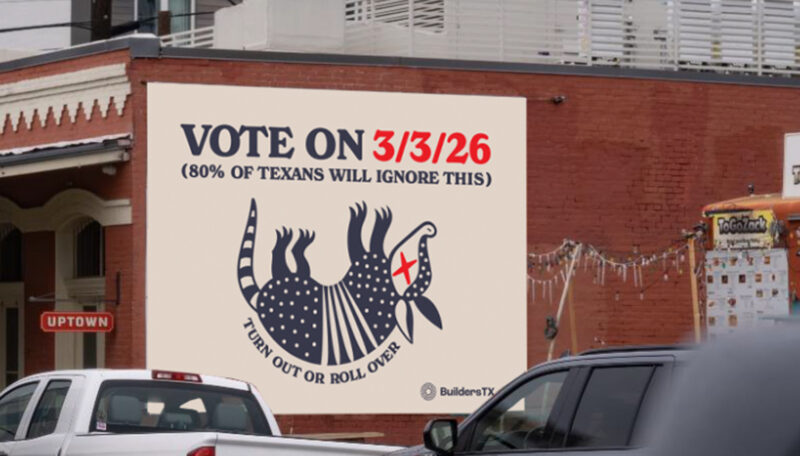
If the urban-rural divide is being exploited for political gain, the most powerful response isn’t another argument online. It’s showing up. In Texas, 4 out of 5 registered voters skip the primary, which means a small, highly partisan group chooses the candidates for everyone else. If you’ve ever felt like the options don’t reflect most Texans, this is why.
Early voting starts February 18. Primary Day is March 3. Showing up on these dates is the best way to push back against the extremes and ensure that problem-solvers, not pot-stirrers, are on the ballot.
You don’t have to convince anyone to care. Just make participation normal. Go with a friend. Share the dates. Keep it simple.
The people who profit from division want Texans fighting. They don’t want Texans voting. Showing up breaks the cycle and puts the power back where it belongs.
—Alex Buscemi (abuscemi@buildersmovement.org)
Art by Matthew Lewis
Keep Reading
Don’t Roll Over, Texas
5 Questions to Ask Before You Vote