Editorial
Nearly Half of Americans Now Identify as Political Independents


Gallup Poll Finds New High of 45% in U.S. Identify as Political Independents — Here’s What That Means for the Future of Politics
American politics can feel like a constant tug-of-war.
Red versus blue. Left versus right. Us versus them. The rope has been pulled so hard for so long that a record number of Americans have simply let go.
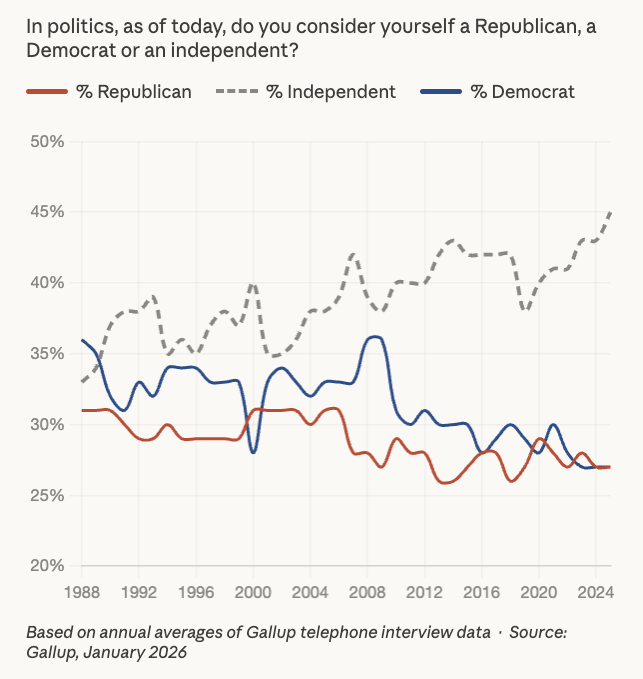
An all-time high 45% of Americans now identify as political independents, according to a Gallup study released in January 2026, based on interviews with more than 13,000 U.S. adults throughout 2025. That makes independents not just a growing group, but the largest political bloc in the country, outpacing both Democrats and Republicans, who each sit at 27%.
It’s worth noting that “independent” here doesn’t refer to a registered third party. Rather, this data shows how Americans think of themselves politically.
Independents have been the largest group in most years since Gallup started phone polling in 1988. What’s different now is that the floor keeps rising: the independent share rarely broke 40% before 2011, and has stayed above it ever since. The new 45% record is the latest step in a long climb. Combine that with the generational data showing each new cohort entering adulthood more independent than the last, and you’re looking at a structural shift.
Gallup’s analysts say that these swings in alignment are partly driven by dislike of whoever holds the White House. When a president becomes unpopular, independents (those with weaker ties to either party) tend to drift toward the opposition. We’ve seen this pattern play out in both directions: Democrats lost ground during Biden’s tenure, and Republicans have now shed similar support under Trump’s second term.
But that’s only part of the story.
The deeper signal may be that more Americans are stepping back from a political culture that increasingly asks them to pick a side rather than find solutions.
Stepping Outside the Binary
In today’s political environment, the loudest voices often come from the edges. Social media rewards outrage. Cable news amplifies conflict. And political incentives can push leaders toward sharper, more divisive messaging.
For many Americans, that environment doesn’t feel like a place to get things done. It feels like a place to choose teams.
Identifying as independent can be a way of opting out of that dynamic. Not because people don’t care about issues, but because they don’t see their views fully reflected by either party.
Importantly, being independent doesn’t mean being disengaged. The label is less about neutrality and more about flexibility: the freedom to evaluate issues without automatic allegiance.
A Generational Shift
This trend is especially pronounced among younger Americans.
A majority of Gen Z adults now identify as independents (56%), higher than millennials at the same stage of life (47%) and far above Gen X in the early 1990s (40%). Millennials and Gen Z have carried that identity with them as they’ve aged, rather than “settling into” party affiliation the way previous generations often did.
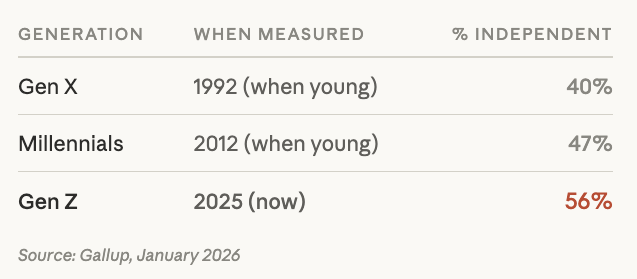
If younger voters continue to identify as independents at these rates, it could reshape how politics works in the decades ahead. Candidates may need to appeal less to party loyalty and more to a broader set of voters who expect nuance, flexibility, and problem-solving over partisanship.
At the same time, ideological labels are shifting. In 2025, 35% of Americans identified as conservative, 28% as liberal, and 33% as moderate, with the gap between conservatives and liberals narrowing to one of the smallest margins Gallup has recorded.
That mix reflects a country that doesn’t fit neatly into two boxes.
An Opportunity to Build
For those who care about moving beyond “us vs. them,” this moment presents an opportunity.
If more Americans are less anchored to party identity, they may also be more open to working across differences to solve shared problems.
That doesn’t mean disagreement disappears. It shouldn’t. Disagreement is a healthy part of a functioning democracy.
But there’s a difference between disagreement and division.
A politics defined by division asks: Which side are you on?
A politics focused on problem-solving asks: What can we fix together?
The rise of independents suggests more Americans may be ready for the second question.
And that’s where building begins.
— Alex Buscemi (abuscemi@buildersmovement.org)
Art by Matthew Lewis
Keep Reading
Nearly Half of Americans Now Identify as Political Independents

Is Texas Running Out of Water?