Editorial
The 2026 Midterms Will Decide More Than You Think. Here Are 5 Reasons Your Vote Matters


By Alex Buscemi, Editorial Manager at Builders
Continue Reading for Free!
Every election gets called “the most important of our lifetime,” so often that the phrase has lost most of its meaning. But strip away the hype and look at the actual stakes of November 3, and this one earns a closer look. The margins are razor-thin, the consequences are enormous, and the outcome will shape American life well past 2026. Here are five concrete reasons it matters and why your vote carries more weight than you might think.
1. A handful of seats will decide who runs Congress
Congress is operating on margins narrower than economy-class legroom. Republicans hold the House 218 to 214, with one independent who sits with them and two vacant seats, so Democrats need a net gain of just three seats to take over. In the Senate, Republicans hold 53 seats to the Democratic caucus's 47, and because Vice President JD Vance breaks 50-50 ties, Democrats need a net gain of four.
Why the obsession with a seat here or there? Because a 51-49 Senate and a 49-51 Senate produce completely different laws, investigations, and confirmations, as the next four reasons show.
2. The winners set the agenda for Trump's last two years
Whichever party holds the gavel decides which bills get votes — and which officials get subpoenaed.
If Republicans keep both chambers, they say they will make tax cuts permanent and increase defense spending.
Republicans are campaigning on the 2025 tax law they now call the Working Families Tax Cuts, which made the 10%-to-37% income tax brackets permanent. Some of the law's most popular breaks, including deductions of up to $25,000 in tips and $12,500 in overtime pay, expire after 2028, and Republicans want them extended.
President Trump has added a bigger promise: a $5,000 payment to every adult citizen if Republicans win both the House and the Senate. Voters seem skeptical, with 57% doubting the checks would arrive even if Republicans held Congress.
The defense numbers are even bigger. The White House's fiscal 2027 request calls for $1.5 trillion in national defense spending, up from about $1 trillion in 2026.
If Democrats win the House, they’ll try to undo Trump’s tariffs, restore ACA subsidies, and maybe even impeach Trump.
Minority Leader Hakeem Jeffries has said Democrats "haven't ruled anything in" or out on impeaching Trump. Republicans are campaigning on the possibility that they will impeach. Trump told an Oklahoma rally that if Republicans lose, Democrats will impeach him, and Majority Leader Steve Scalise has predicted it would happen on "day one.” The House can impeach by simple majority, but removal takes 67 Senate votes, which neither party is close to.
Jeffries says his top legislative goals would be undoing Trump's tariffs, forcing a wind-down of the Iran war, and restoring Affordable Care Act (ACA) subsidies that expired this year. On taxes there's no single Democratic plan, though Sen. Cory Booker's Keep Your Pay Act would raise the standard deduction to $75,000 for married couples and lift the top rate to 43%.
If control is split, we’ll get gridlock with a side of shutdown.
Trump keeps his veto pen no matter what happens, and overriding it takes two-thirds of both chambers. GWU's Todd Belt expects a Democratic House to mean more fights over the 12 annual spending bills, and with them more shutdown risk. He also predicts Trump would pivot toward foreign policy, as presidents facing divided government tend to do.
3. Governors will help draw the 2028 Congressional map
Congressional maps used to be treated like wedding china: brought out once a decade, after the census, and handled carefully. But since summer 2025, ten states have adopted new maps, and eight are in force next week: Texas, California, North Carolina, Ohio, Utah, Florida, Tennessee and Louisiana.
Where do governors come in? In most states the legislature draws the map and the governor signs or vetoes it, so a single governor's race can decide whether a redraw happens at all.
The party that draws the lines can effectively choose its own voters. Pack the opposition into a few districts or scatter them across many, and you can bank seats before a single ballot is cast. That’s how a map can lock in an advantage that outlasts any one candidate, shaping who wins for the rest of the decade regardless of how people actually vote.
And since a governor can be the difference between a map being redrawn or left alone, the person you elect to that office holds sway over elections long after their own race is forgotten. A vote for governor is, in a real sense, a vote on every congressional race that state will hold for years.
4. Record-breaking money is riding on the outcome
If you want to know how much the people with the most at stake care about an election, follow the ad buys. As of October 27, political ad spending and reservations for this cycle hit $11.21 billion. That already tops the entire 2024 presidential cycle, which is a first for a midterm.
The 50 largest donors have put in $2.77 billion so far, according to an Al Jazeera analysis of Federal Election Commission data. Republican-aligned contributors account for $1.67 billion of that, about twice the $832 million from Democratic-aligned contributors.
Elon Musk leads all individuals with $446 million to Republican-aligned groups, followed by Uline founders Richard and Elizabeth Uihlein at $150 million and Jeff and Janine Yass at $110 million. On the Democratic side, George Soros has given $102 million, Mike Bloomberg $84 million, and Reid Hoffman and Michelle Yee $41 million.
Industry is in the mix as well: Coinbase has given $57.8 million, Ripple $49.6 million and DraftKings $40.4 million.
The size of these bets tells you how much both sides think the result matters.
5. Supreme Court justices are floating retirement, adding another layer to the Senate vote
The Senate confirms Supreme Court justices, so control of the chamber in 2027 and 2028 will decide whether President Trump can fill any vacancy before his term ends. That question has become more pressing because the Court's two oldest members, Clarence Thomas, 78, and Samuel Alito, 76, are both conservatives, and Alito has said he has thought about retiring.
Alito has since said he plans to serve through the current term, which ends in June 2027, even if Democrats win the Senate. Thomas has made no public comment about retiring. If a seat opened after Election Day, Republicans would control the Senate until January 3, about four and a half work weeks, and Majority Leader John Thune has said a lame-duck confirmation can be done. After that, a Democratic majority would effectively hold a veto over any nominee.
Both parties remember recent precedents: Republicans blocked Merrick Garland's nomination for 293 days in 2016, then confirmed Amy Coney Barrett less than a month before the 2020 election. Justices serve for life, so a single confirmation could shape the Court for decades.
Midterms will never get the same hype as the presidential elections. But they decide who controls Congress, which bills get a vote, whose maps shape House races for years to come, and who confirms the justices who will sit on the Supreme Court for life.
With control of both chambers likely to come down to a handful of close races, a smaller electorate will make decisions that affect everyone. That’s what gives each vote its weight. If you haven’t made a plan to vote yet, now is the time to make one. Check your state's official election website or vote.gov for polling places, hours, and ID rules.
Need help making sense of the midterms? We've got you covered.
Alex Buscemi can be reached at abuscemi@buildersmovement.org
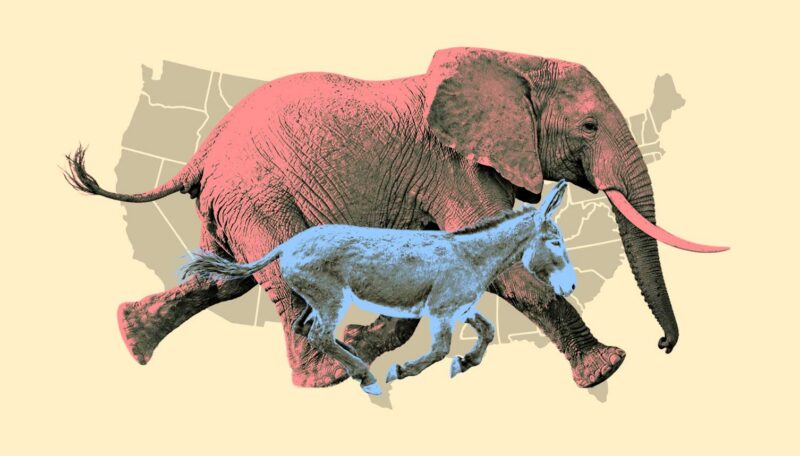
Art by Matthew Lewis(opens in new tab)
Keep Reading
The 2026 Midterms Will Decide More Than You Think. Here Are 5 Reasons Your Vote Matters

5 Traits That Make a Politician Good at Their Job (According to Science)