Editorial
Here’s Why Only One-Third Of Americans Think Democracy Is Working in the U.S.


Satisfaction with democracy is deep in the hole.
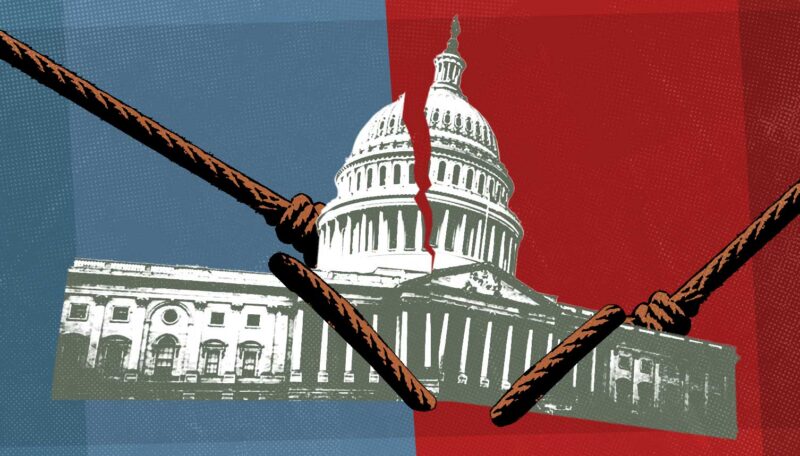
Only 34% of Americans are satisfied with how democracy is working in the U.S., according to a 2025 Gallup poll. Overall, Americans’ satisfaction with democracy has been in steady decline from its peak of 60% in the mid-1980s.
This persistent disillusionment has given rise to the idea that perhaps we shouldn’t have democracy at all—at least in its current form. Only 67% of Americans say democracy is the best form of government. Which begs the question: what alternative do people think would work better?
Most Americans still believe in the actual values that make democracy work. 80% think leaders should compromise across party lines. 84% say the country is stronger because of its diversity.
So it would seem that people haven't given up on democracy itself. They've given up on the version of it they're experiencing right now.
It's like when your cousin tried to bake Grandma’s fantastic cake recipe, but it ended up tasting like sawdust and sadness. This isn’t a problem with Grandma's recipe. It's proven over generations to be a delicious cake. The problem is the baker.
Likewise, Americans are not rejecting the blueprint of democracy—the recipe on which our country is built. They're demanding a democracy that actually functions the way it's supposed to. And the gap between what they believe democracy should be and what they see every day is where the cynicism lives.
If all you see is endless division, why would you trust democracy?
For a lot of Americans, especially younger ones, democracy hasn't looked like progress. Government shutdowns have increased in frequency over the past decade—and they’re lasting longer than ever. President Ronald Reagan presided over eight government shutdowns during his tenure, but the longest lasted only three days. Last fall, our government came to a halt for a whopping 43 days, the longest shutdown in history. And spending bills are rarely—if ever—passed on time anymore. If your earliest political memories are characterized by constant gridlock, culture wars, and politicians who prioritize winning over solving problems, being skeptical doesn't seem extreme. It seems rational.
From that angle, doubting democracy isn't about rejecting freedom or fairness. It's asking a legitimate question: if this is what the system produces, why should I keep believing in it?
That's not a problem with people's values. It's a problem with what they've lived through.
Do people who want an alternative to democracy have a point?
When people say they want an alternative to democracy, they typically mean an authoritarian leader who has the power to do what they want without the slog of earning congressional approval.
In some ways, I get it. Democracy is slow. Watching problems stack up while leaders argue makes any system that promises quick action sound appealing.
But history is pretty clear about what those alternatives cost.
Systems that trade participation for efficiency don't just move faster—they concentrate power. They solve short-term dysfunction by creating long-term danger: fewer voices, fewer checks and balances. They replace debate with obedience and a fear that if you do disobey, you will be severely punished.
So yes, their frustration is valid. But the solution they're reaching for creates problems far worse than the ones we have now.
How we restore faith in democracy
If we want Americans to believe in democracy again, we can’t just lecture them about how important it is. We show them it can actually work.
That means creating spaces where people with different views solve problems together. Making compromise courageous—not as giving up, but as making progress. Elevating regular citizens instead of just the loudest voices. Replacing performative politics with practical wins that people can feel in their daily lives.
Builders’ Citizen Solutions session proved that agreement across differences is not only possible—people on both ends of the political spectrum desperately want it. The session gathered a group of 14 strangers from across Texas with very different backgrounds and beliefs and tasked them with finding solutions to the state’s healthcare crisis: namely, the vast number of citizens in the state who are uninsured. Participants found that although they disagreed on plenty, when the labels were stripped away—red and blue, left and right, conservative and progressive—finding common ground on the issue came far more effortlessly than many had anticipated.
Although solving these problems feels like a deeply systemic issue that may be impossible to tackle as an individual, there are plenty of things you can do to help democracy make its comeback.
Show up locally. Attend a school board meeting. A town hall. A library forum. Democracy feels broken when it feels distant—local is where it becomes real again.
Get involved in a civic space. Volunteer group. Faith community. Neighborhood association. Sports league. Democracy grows where relationships do.
Vote—but also stay engaged after. Democracy isn’t a one-day event. Follow what happens after elections. Ask questions. Stay curious instead of cynical. (More on this soon—keep your eyes peeled on how to “vote like a Bulder”).
And lastly, talk to people outside your bubble. Not to “convert” them—just to understand them. Trust is rebuilt conversation by conversation.
A moment worth rising to
America is approaching its 250th anniversary. That milestone isn't just something to celebrate—it's a moment to ask what kind of democracy we want to carry forward.
Not institutions stuck in gridlock and grievance. Not a citizenry held together by nostalgia or fear. But a Democratic Republic of We the People, renewed through participation, courage, and the willingness to thrive as a nation despite our differences.
The truth is, Americans haven't stopped believing in democratic values. They're waiting for democracy to deliver on its promise—that we all live freely, make personal choices, and seek fulfillment. Our Democratic government’s role is to protect these rights.
That's not a reason for despair. That's a reason to do something.
Because the future of democracy won't be saved by louder arguments or extreme politics, it will be rebuilt by citizens who refuse to give up on each other and who decide that the next chapter of America should be written in common ground, not division.
—Alex Buscemi (abuscemi@buildersmovement.org)
Help turn common ground into real change
You’re a Builder, which means you, like us, believe that most Americans agree more than the loudest voices want us to believe—and that solutions are possible when people come before politics. In a world where extremists seek to divide for power and profit, Builders take action to unite, create, and bring light to the world. Support the development of new media, tools, and platforms to help us give power back to the people.
Keep Reading
The 6 Issues Voters Care About Most Heading Into the Midterms
An Israeli, a Palestinian, and a Room Full of Students