Editorial
Builders Like You Just Scored a Huge Legislative Victory for New Moms


How a politically diverse group of ordinary Wisconsin citizens turned a kitchen-table idea into the law of the land — and made their state the 49th to guarantee a full year of postpartum Medicaid coverage.
When Governor Tony Evers stepped to the podium at a Wisconsin children’s hospital last Wednesday to sign legislation extending postpartum Medicaid coverage for thousands of vulnerable mothers, the crowd around him consisted of pro-birth conservatives and pro-choice progressives, suburban parents and rural legislators, people who voted for Donald Trump and people who knocked on doors for Bernie Sanders. In this moment, their differences were irrelevant.
The signing makes Wisconsin the 49th state in the nation to extend postpartum Medicaid coverage from 60 days to a full year — a change predicted to improve maternal health outcomes for roughly 5,000 Wisconsin women annually.
"This is about people, not politics," said Representative Patrick Snyder, a Republican co-author of the bill. The Assembly passed the bill by a stunning 95-to-1 margin.
“The will of the people is the law of the land,” added Democratic Representative Robyn Vining, who collaborated with Snyder.
Standing next to the Governor and decked out in her Builders best, Kai Gardner Mishlove, a Democrat turned independent who has supported both conservative and progressive causes, quietly celebrated a moment she — and many others — had been working toward for years.
"I was ecstatic to witness the bill signing," she said. "I also felt like crying because it took so long to pass. I said a prayer for the women and babies who suffered because of coverage that was previously limited."
From a Citizen Solutions Session to the Governor’s Desk
The road to last week’s legislative victory began, improbably, in 2023 at one of our Citizen Solutions sessions. This problem-solving process, which typically takes about three days, is facilitated and requires a commitment to curiosity and compassion from all participants. In Madison, just steps from the State Capitol, we convened fourteen ideologically diverse people from across the state to find common ground on abortion and family well-being.
Jeff Davis, a Catholic conservative from Bloomington, which sits near the Iowa border, arrived skeptical. “At the beginning, I couldn’t fathom us agreeing on anything,” he recalled.
But the sessions — informed by presentations from experts — created the conditions for a different kind of conversation. “The conversations were tense at times but necessary in order for folks to break down their biases and assumptions,” Kai said. “This opened up avenues for us to see the humanity in each other.”
The process worked, participants say, precisely because it did not ask anyone to abandon their values. Instead, it invited them to discern where those values overlapped. In examining their commitment to helping moms and babies thrive, the group wondered: what happens when a mother loses access to healthcare coverage just 60 days after having a baby?
The answer, it turned out, was something everyone in the room found unacceptable.
[caption id="attachment_46821" align="aligncenter" width="600"]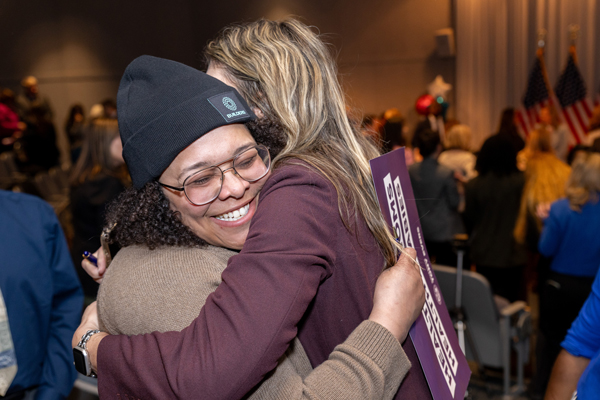 Ali Mudrow (left) and Dr. Kristin Lyerly celebrate the passage of a bipartisan bill to extend Medicaid postpartum. Top image: left to right: Jeff Davis, Dr. Kristin Lyerly, Ali Muldrow, Gov. Tony Evers, Pat McFarland, Kai Gardner Mishlove (Photo by Lindsay Stayton)[/caption]
Bipartisan Support Wasn’t Enough — Until It Was
When the citizen coalition took their consensus to the Capitol, they had polling on their side: a 2024 Builders survey found 73% of Wisconsinites supported the extension, and a 2025 Marquette Law School poll showed 66% of registered voters favored it. At first, it seemed the policy’s bipartisan appeal extended to lawmakers, with majorities of Republicans and Democrats behind it. But Speaker Robin Vos refused to allow a vote on the Assembly floor, once saying, “We already have enough welfare in Wisconsin.” In the political version of hot potato, the bill bounced from committee to committee without a vote.
"I was surprised that we were met with so much resistance in the Assembly," Jeff said. There was significant resistance among certain legislators who were skeptical of Medicaid expansion in any form — resistance that persisted even as the bill’s broad public support became undeniable. The citizens adapted. "It was very helpful to show them that there was bipartisan support among us,” Kai recalled, “so why not them?"
Over two years, the local Builders worked together to push the bill across the finish line. “I participated in a series of coordinated social media posts, op-eds, media interviews, and visits with elected officials — all with the purpose to raise awareness regarding the positive health, community, and economic benefits of this legislation,” Kai said.
Mounting pressure from lawmakers and the public finally convinced Vos to put the bill to a vote. “This process has shown me that well-informed citizens have the power to move legislation forward,” Jeff said.
The Human Cost of a 60-Day Clock
Emily Schmit, a mother from Mount Horeb, gives this debate a human face. In 2018, her son was born prematurely and spent his first 60 days in the neonatal intensive care unit. Just as her family was finally able to bring him home, her Medicaid coverage expired.
"Having a full year of coverage would have enabled me to continue seeing my doctor, accessing medications, and accessing mental health professionals to process my traumatic birth experience," Emily said. "I’m grateful Wisconsin moms will now have the extended support that I needed."
Stories like Emily’s are not isolated. Data from the Centers for Disease Control and Prevention shows that roughly 53% of maternal deaths occur between 7 and 365 days postpartum, demonstrating a need for extended coverage to adequately meet moms’ physical and mental healthcare needs. Now, Arkansas is the only state with a coverage gap.
A Model for What Comes Next
We’ve run a similar Citizen Solutions project in Tennessee, where a citizen cohort helped contribute to the passage of bipartisan firearms safety education legislation for students. Late last year, we took the process to Texas, where a cohort of 14 began tackling the resonant issue of healthcare.
The model we’ve developed is, at its core, a bet that ordinary people can find common ground solutions – often more efficiently and consistently than elected leaders operating in a polarized system.
The Power of the People
Before joining Builders, Kai said she was uncertain whether ordinary citizens could meaningfully influence legislation outside of election years. The bill signing gave her a definitive answer.
“Don’t ever give up on the possibility of folks successfully working together across political divides to meet a common goal,” she said
Jeff echoed Kai’s optimism. “Your voice does matter,” he said. “The real question is: do you care enough to make it matter?”
As “2025 Wisconsin Act 102” became official, the question seemed, for a moment, to answer itself.
— Alex Buscemi (abuscemi@buildersmovement.org)
Keep Reading

The 6 Issues Voters Care About Most Heading Into the Midterms
An Israeli, a Palestinian, and a Room Full of Students