Editorial
4 Unifying Moments in the Face of Political Violence


On Saturday night, shots were fired outside the ballroom of the White House Correspondents’ Dinner. President Trump, the First Lady, Vice President Vance, and members of the Cabinet were rushed to safety. A Secret Service officer was struck in the chest — saved by his vest. A suspect was arrested. No one was killed.
By the next morning, the predictable forces of division were already at work. Conspiracy theories spread. Partisan blame was being assigned. Cable news filled airtime with heat.
But before all of that — in the immediate moments after the gunfire — something else happened. Here are four moments worth paying attention to.
Moment #1: Trump Called for Unity, And Meant It
Whatever you think of President Trump, his initial response is worth examining on its own terms. In prepared remarks at the White House shortly after the shooting, he asked that “all Americans recommit with their hearts in resolving our differences peacefully,” adding: “You had Republicans, Democrats, independents, conservatives, liberals and progressives… but yet everybody in that room… there was a tremendous amount of love and coming together.”
He also pushed to reschedule — not cancel — the dinner with members of the press. Is this the same Trump who has called the press “the enemy of the people”? Yes. Which is exactly what makes these words worth noting. People can surprise us; that’s a Builders principle.
Moment #2: A Republican Reached Across the Aisle — Literally
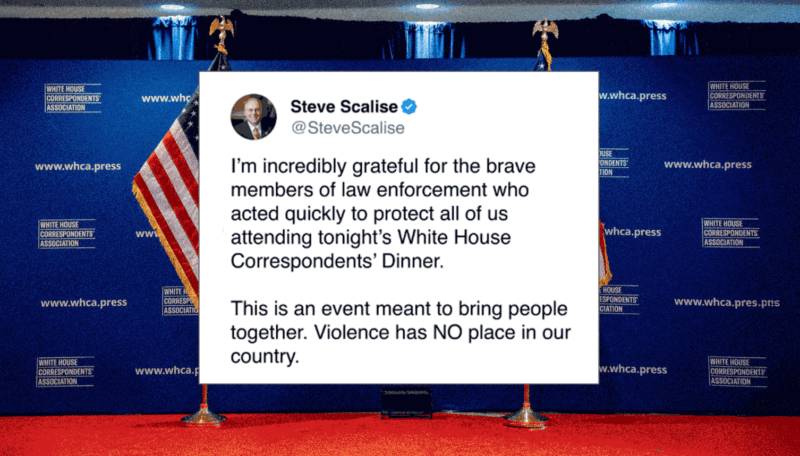
When shots rang out and hundreds of people dove under their tables, House Majority Leader Steve Scalise — a Republican who was himself shot and nearly killed at a congressional baseball practice in 2017 — didn’t think about party lines.
Scalise saw Democratic Representative Jared Moskowitz of Florida pop up and ask for help, and without thinking, he had his security pull Moskowitz into a secure room reserved for Congressional leadership — a room Moskowitz wouldn’t have been allowed in without Scalise’s help.
Moskowitz thanked Scalise publicly and captured the particular weight of the moment: two people supporting each other in a moment of crisis. No party. No politics. Just one human being helping another to safety.
Moment #3: A Journalist and a President Found Common Ground
The White House Correspondents’ Dinner exists at the intersection of two institutions that are often at odds: the White House and the press.
White House Correspondents’ Association President and CBS News correspondent Weijia Jiang — who was seated at the head table with Trump when the shots were fired — described him calling her into his holding room afterward to speak directly. Trump told Jiang that he realized “how important that night was” and that he was not going to be deterred. She reminded the room that “the freedoms that we are celebrating tonight in the First Amendment are still incredibly fragile.”
She added: “I appreciate that the president acknowledged that, and he told me that we were not going to be deterred. He refused to stand down.” A president and a journalist, choosing to connect in a moment of shared fear. That’s compassion. That’s courage. That’s what being a Builder looks like in real life.
Moment #4: Democrats Condemned Violence and Pushed for Calm
Rather than ratcheting up political tensions during an already heated moment, many Democratic officials shared messages of unity and support. On Sunday, former President Obama said, “it’s incumbent upon all us to reject the idea that violence has any place in our democracy.” Michigan Senator Elissa Slotkin added, “I am grateful that the President and all the guests from last night’s event are safe … we should all be clear that political violence has no place in America.”
Even one of Trump’s loudest critics, California governor Gavin Newsom, shared, “Relieved everyone at the White House Correspondents’ Dinner is safe tonight based on initial reports. A free press is foundational to our country. Violence is never acceptable.”
What We Do With This
These four moments won’t make the news cycle the way the conspiracy theories will. They won’t trend the way the outrage will. But they’re real — and they matter. They might even be an opportunity.
Here’s the thing: it shouldn’t take a crisis to make us drop the labels. If there can be a silver lining from this incident, maybe it’s to show us how we could behave outside of a crisis.
What would it look like if we recognized that if everyone agrees political violence has no place here, then the work has to match that standard? Maybe we would start to see real change — not just in words, but in behavior over time.
– Builders Editorial Team
Keep Reading
4 Unifying Moments in the Face of Political Violence

When the 5th & 8th Largest Economies in the World Come Together