Editorial
An Israeli, a Palestinian, and a Room Full of Students


Our sister organization, PeaceWorks, brings lessons in empathy to college campuses
By Alex Buscemi, Editorial Manager at Builders
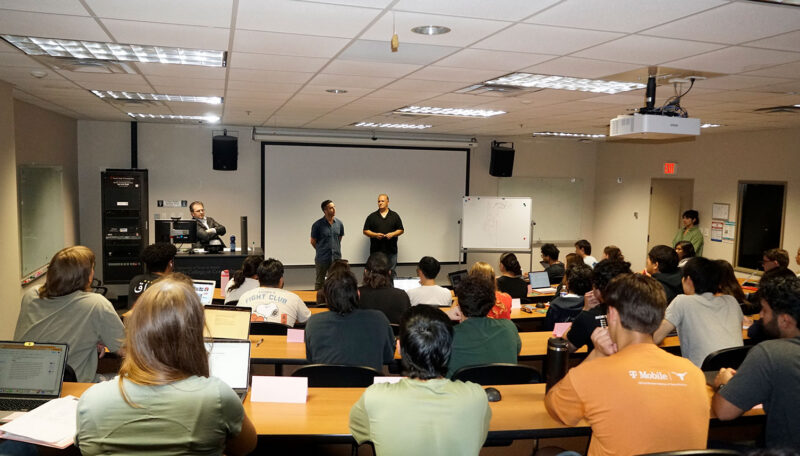
An Israeli and a Palestinian stood side by side at the front of a lecture hall at the University of Texas at Austin. It was the latest stop on the PeaceWorks On Campus tour, which brings peacebuilders from the two nations to campuses across the US, creating dialogue-driven learning experiences for students.
“How can you have empathy for Israel after all that’s happened?” The question came from a student in the second row. He sounded flustered. Contemptuous.
The question was directed at Ezzeldeen Masri, 55, who grew up in the Gaza Strip and has been a member of PeaceWorks since 2006.
"When you see people on the other side who also want peace, who also condemn violence, then you start to change," he replies. He speaks loudly, urgently, but with the composure of someone who has made this argument many times and means every word. “Empathy is the only way to peace.”
PeaceWorks, a sister organization of Builders, ultimately hopes that Israel and Palestine can establish a two-state solution. But before that can happen, they believe the dialogue surrounding the conflict needs to become more productive.
Standing beside Masri is Roey Kruvi, 38, who was born in Israel and came to America at age 10. He tells me after the meeting that students deserve better than the toxic us-versus-them discourse dominating college campuses.
“They deserve spaces where hard conversations happen without combat or threat, and where pragmatism and solutions carry more weight than extreme positions,” he says. “If they watch an Israeli and a Palestinian do it, without agreeing on everything, they'll know they can do it too.
“These students are our future leaders, and America's role in the world is enormous,” he adds. “I want them to step into those roles with curiosity rather than certainty.”
The PeaceWorks tour, which visits nearly fifty campuses per semester, doesn't shy away from the ugly realities of the conflict. During the UT presentation, Masri tells the students he threw rocks at IDF soldiers as a teenager (at this, a student in the front row breaks into applause). He talks about his home being destroyed in the aftermath of October 7 and condemns Israeli settlers “wreaking havoc” in Palestinian territory. There's heat in his voice, but it's the controlled heat of a kiln, not a wildfire.
He tells the students that “peace-building is a career.” That changing perceptions about the other side is a lifelong commitment — even for him. Growing up in Gaza, he had no empathy for Israel. At 17, he joined the United National Leadership of the Uprising, the clandestine Palestinian body that coordinated the First Intifada. He traveled to Chicago in the summer of 1990 to study political science at Northeastern Illinois University. His travel documents issued by the Israeli Army listed his nationality as “Stateless.”
“What changed my mind was meeting and working with Israelis who showed empathy toward us, the Palestinian people,” he tells me.
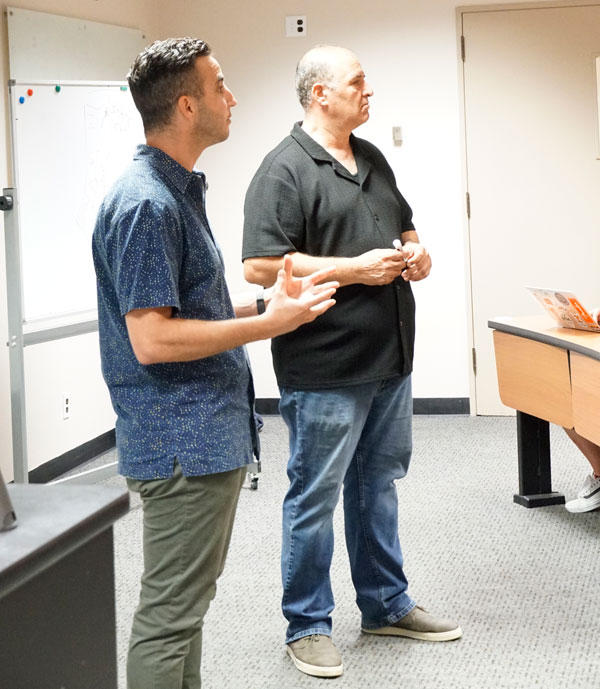 Roey Kruvi (left), who grew up in Israel, and Ezzeldeen Masri, a Gaza native, speak to students at UT Austin.
For Kruvi, there were two key moments that changed the way he viewed Palestinians.
“The first was in college, when I met a Palestinian for the first time and saw how much we shared. Love of the land, the food, the culture, deep ties to family and community.
“The second was the year YouTube came out. For the first time, I saw what daily life in the West Bank looks like under military occupation. Checkpoints, illegal settler outposts. I simply didn't know. Israeli media rarely showed that life, and since I didn't serve in the IDF, I never saw it myself. I grew up with gruesome images of terror attacks against Israelis. I had never seen what life looked like for Palestinians.”
Inspiring empathy for the other side sits at the core of the PeaceWorks mission. A large part of that is teaching students that neither Palestinians nor Israelis are monolithic in their beliefs. Campus discussions on the conflict, especially in a post-October 7 world, tend to take place along picket lines, with absolutist positions shouted over one another or scrawled on signs.
Kathryn Baldovino, a sophomore communications major, tells me the PeaceWorks event stood in stark contrast to the discussions she’s used to having with friends about Israel and Palestine.
“I think it’s great to hear from people who are directly involved,” she says. “I was surprised how [Masri and Kruvi] approach the conflict, especially given that the media tends to amplify the most extreme voices.”
Kruvi says that’s the most common takeaway students have after a PeaceWorks session: they’re surprised to learn that there are people on both sides who want to coexist.
“The voices on social media demanding they pick a side don't speak for the Israelis and Palestinians working for a better future every day,” he says. “And there is hope. Israelis and Palestinians are working right now to bring their people together.”
Masri echoes this sentiment: “As a peacebuilder, I must radiate hope for the people around me and the people I meet. This is not a choice, but part of my work.”
He holds hope for an end to the military occupation “that is making our lives miserable.” Hope that he will one day look down at his travel documents and see “Palestine” written under “Nationality.”
“I will have a state of my own,” he says. “I won’t be ‘Stateless!’”
As the session came to a close, Dr. Larry Schooler, the event’s moderator, made a simple request of the students: “If you learned anything today, would you stand up?”
Nearly everyone rose to their feet. They looked around in surprised silence.
Schooler continued: “If you feel motivated to contribute not only to this organization but to the cause for which they are working, would you remain standing?”
No one budged.
In that moment, an Israeli, a Palestinian, and a room full of students stood together.
To learn more about PeaceWorks or bring them to your campus, click here.
Alex Buscemi can be reached at abuscemi@buildersmovement.org(opens in new tab)
Keep Reading
The 6 Issues Voters Care About Most Heading Into the Midterms
An Israeli, a Palestinian, and a Room Full of Students