Editorial
Part of Builders Texas
The 5 Styles of Texas Barbecue (and What They Say About Us)


By Alex Buscemi, Editorial Manager at Builders | 7 min read
Texas barbecue is one of the few things nearly every Texan will argue about and still happily share. And if you look closely at what's on the plate, you'll notice something remarkable: the state's barbecue isn't one tradition at all. It's five distinct regional styles, each one born from a different people who came to Texas, brought the cooking of their homeland, and made it their own over generations.
That's the miracle of it. A German butcher's smoking technique, a Mexican family's pit dug into the earth, an African American church cook's tomato-based sauce, a cowboy's open mesquite flame, a big-city chef's global spice rack. None of them agreed on the "right" way to do it. All of them are unmistakably Texan. Every plate is a little edible history lesson in how wildly different traditions can end up under one roof and make the whole thing better.
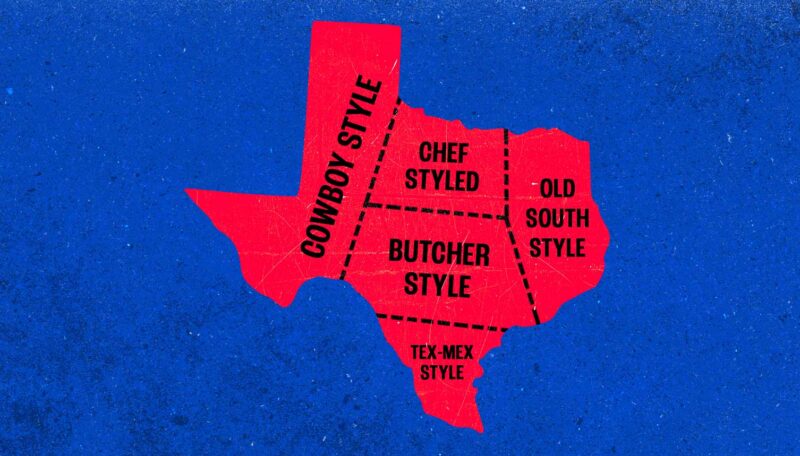
Here are the five great styles of Texas barbecue, and what each one says about the people who built it.
1. West Texas: Cowboy Style
Out in the arid, wide-open west, barbecue looks the way the land does: rugged and unfussy. Cowboy style is cooked over direct heat, the meat set right above the flame in a method much closer to grilling than to the low-and-slow smoking most people picture. The wood is mesquite, because in the desert it's often the only tree around, and it gives the meat a bold, earthy char. You'll find chicken, pork chops, sausage, goat, and ribs more often than a giant brisket, since brisket needs hours of slow smoke this method doesn't provide. Sauces here lean spicy and tomato-based, carrying a Mexican influence with cumin and chilies.
This is the barbecue of ranch hands and trail cooks who had to feed a crew with whatever fuel the frontier offered. It's the taste of self-reliance and making do, the frontier spirit that still defines West Texas today.
2. Central Texas: Butcher Style
This is the style the rest of the world pictures when it hears "Texas barbecue," and it comes straight from the German and Czech immigrants who settled the Hill Country in the 1800s and opened meat markets. Their genius was practical: smoke the cuts that didn't sell so they wouldn't spoil. What started as thrift became an art form.
The method is low and slow over post oak, sometimes pecan, for up to eighteen hours. The seasoning is almost defiantly simple, usually just salt and black pepper, letting the smoke and the quality of the beef do the talking. Brisket is king, alongside handmade sausage that still uses the coarse-grind, garlic-and-spice techniques brought over from Central Europe. The meat comes piled on butcher paper, sold by the pound, with white bread, pickles, onions, and jalapeños on the side. And the sauce? Served on the side, if at all. In Central Texas, drowning good brisket in sauce is close to an insult. This is barbecue as patience and craftsmanship, a whole culture built on the belief that if you do the hard, slow work right, you don't need to hide it.
3. South Texas: Tex-Mex Style
Head toward the Rio Grande and the border stops being a line and starts being a blend. South Texas barbecue is where Texan smoke meets Mexican barbacoa, a tradition of cooking meat in a pit dug into the ground, lined with stone, fired with mesquite burned down to coals, then covered with maguey or leaves and left to cook low overnight.
The signature dish is barbacoa, traditionally the whole head of a cow, though today you're more likely to get cheek or brisket, served with tortillas, salsa, guacamole, and onions rather than a squeeze bottle of sauce. Fajitas, another South Texas gift to the world, come from the same roots. This is food that refuses to recognize a hard border between cultures, a delicious argument that the mixing of two peoples can produce something neither could have made alone.
4. East Texas: Old South Style
Cross into the piney woods of East Texas and barbecue takes on the deep flavors of the American South, with African American pitmasters at the heart of its story. Food historians trace this style to Black cooks and the family reunions, church gatherings, and community cookouts where it was perfected across generations, often out of the necessity of making humbler cuts sing.
The method is still low and slow, most often over hickory, cooked until the meat is falling-off-the-bone tender. Then comes the thing Central Texas would never do: a thick, sweet, tomato-based sauce, poured on rather than served beside. Meat is usually chopped, piled on a bun, and handed over as a sandwich, with sides like collard greens, mac and cheese, and banana pudding rounding out the plate. This is barbecue as generosity and gathering, a tradition forged in community and built to feed a crowd with love. It's a style that deserves far more credit than history has given it, since so much of what the whole world calls "Texas barbecue" grew from these roots.
5. North Texas / Dallas: Chef Style
The newest branch on the tree grows in the big cities, especially Dallas, where a generation of formally trained chefs has taken the old traditions and run them through a global lens. Chef style keeps the low-and-slow post-oak foundation of Central Texas but treats it as a starting point rather than a rulebook.
Here you'll find brisket rubbed with Korean gochugaru, smoked lamb with chimichurri, boudin that nods to Louisiana, tacos filled with burnt ends, and desserts you'd expect at a fine-dining restaurant. The wood, the method, and the sauces all bend to whatever the chef is chasing. If the other four styles are heritage recipes passed down through families, this one is the sound of all those heritages meeting in a single modern kitchen. It says something true about where Texas is headed: a place where the newest arrivals keep adding their flavor to a pot that's been simmering for two hundred years.
What the Plate Says About Us
Line these five styles up next to each other and you're looking at a map of everyone who ever made Texas home. German butchers. Mexican families. African American church cooks. Frontier cowboys. And the chefs carrying it all somewhere new. Not one of them cooked it the same way. Not one of them is any less Texan for it.
That's the thing worth chewing on. Texas didn't become a barbecue capital by declaring one style the winner and stamping out the rest. It got great because of the mix. Every one of these traditions is somebody's grandparents refusing to let a recipe die, carrying it across borders and hard times and generations until it landed on your plate. The food on that butcher paper is a monument to human tenacity, and it's proof of something this country forgets too often: that our differences, set side by side, make the whole feast richer.
And here's the part that matters most. Barbecue has never really been about the meat. It's about the table it's served on, and the people who pull up a chair around it. For as long as there's been smoke in the air, Texans of every background have set down whatever divided them to share a plate. You can't stay angry at someone who just passed you the brisket.
That's exactly the idea behind the Builders BBQ Challenge. This summer, we're asking people across the country to fire up the grill and invite their neighbors, friends, and family, including someone who might see the world a little differently. More than a hundred of you have already signed up to host a Builders BBQ and claimed a free kit to get started. Why? As one host from Georgetown put it: "I want to bring people with differing beliefs together to chat and figure out what they have in common." And Builders know she's onto something. We have far more in common than the noise would have us believe, and a good meal has a way of bringing it to the surface.
Pull up a chair. There's room at the table for all five styles, and for all of us.
Alex Buscemi can be reached at abuscemi@buildersmovement.org
Art by Matthew Lewis
Keep Reading
The 5 Styles of Texas Barbecue (and What They Say About Us)

Trump Says AI Is ‘Woke’ — Is It? We Asked an AI Expert